Types of stabiliser
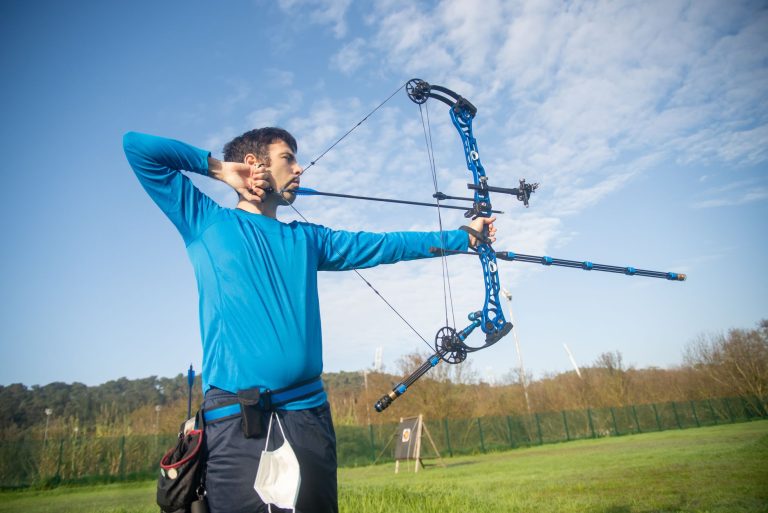
There are several types of stabiliser suited to different shooting styles. Centre stabilisers, generally measuring between 26 and 32 inches (66 to 81 cm), attach to the front of the bow’s riser. They are designed to provide extra stability when shooting. Side stabilisers measure between 10 and 15 inches (25 to 38 cm) and are often used in pairs for recurve bows, while a single one is preferred for compound bows. Finally, hunting stabilisers, shorter and chunkier, measure between 4 and 10 inches (10 to 25 cm) and are designed specifically for compound hunting bows.
Materials
Stabilisers are made from a variety of materials, including woven carbon and high-strength carbon. Woven carbon models generally cost between 15 and 50 euros, while high-strength carbon ones can exceed 80 euros, reaching up to 300 euros for competition models. High-strength carbon stabilisers are particularly popular with competitors for their lightness and stiffness, which can improve accuracy and control.
- Field / range1,941 · 64%
- Archery venue381 · 13%
- Archery club367 · 12%
- Sports centre325 · 11%
- Indoor hall15 · 0%
Stabiliser length and weight
The length and weight of stabilisers play a crucial role in an archer’s performance. Longer stabilisers are often perceived as offering better stability, but the precise effects of these characteristics on shooting accuracy are not clearly established. For beginner archers, the choice of stabiliser may come down to personal preference, as some may feel more comfortable with a shorter, lighter model, while others prefer the stability of a longer stabiliser.

Stabiliser diameter
The standard diameter of stabilisers generally ranges between 12 and 15 millimetres, with wider options at 16 or 18 millimetres. Although wider diameters may offer better vibration absorption, the exact impact of this feature on bow stability is not clearly defined. Archers should therefore consider their personal preferences and shooting style when choosing their stabiliser’s diameter.
Using side stabilisers
Side stabilisers are often used to balance the bow from the sides and bring weight back towards the archer’s centre of gravity. This can help reduce unwanted movement when shooting. However, there is no consensus on the optimal number of side stabilisers for different types of archer. Some archers prefer to use a single side stabiliser, while others opt for a pair for better balance.
Hunting versus target
Hunting stabilisers and target stabilisers are designed for different uses. Hunting stabilisers, shorter and chunkier, suit compound hunting bows, offering better handling in fast shooting situations. Target stabilisers, by contrast, are generally longer and lighter and aim to maximise stability in competition. However, the performance differences between these two types of stabiliser for compound bows are not well established, which can make the choice difficult for some archers.
Ready to shoot?
Find an archery venue near you.
What we don’t know yet
Despite the information available, several questions remain unanswered. The precise effects of stabiliser length and weight on shooting accuracy are not clearly established. In addition, the specific advantages of high-strength carbon stabilisers for beginner archers are not well documented. The exact impact of stabiliser diameter on vibration absorption and bow stability also remains unclear, and the performance differences between hunting and target stabilisers for compound bows require further research.
FAQ — using the directory
Where do the listings come from?
From OpenStreetMap, the open map edited by volunteers. Each listing shows its source and we publish the method on the sources and methods page.
Is Archery Info an official federation directory?
No. It is an independent and unofficial directory with no link to World Archery, national federations or the venues listed.
A venue is missing or wrong. What can I do?
Use the contact page to correct or remove a listing, or fix it at the source on OpenStreetMap.
Can I book a lesson here?
No. We do not sell bookings or lessons; we only show where to find a club or range. Always confirm access with the venue.

Keep reading
Physical conditioning exercises for archery
Discover the essential exercises to get the most from your archery performance. Good physical training is the key to improving your technique…

A practical guide to preparing for an archery competition
Discover the essential steps for getting ready for an archery competition. Follow our guide to maximise your performance and avoid common pitfalls.
Understanding competition bows: a technical approach
Competitive archery calls for a thorough understanding of the different types of bow. This article explores the characteristics and advantages of recurve…